


Scripted Learning: Assessing How Medical Dramas Shape Pharmacy Students’ Confidence as Patient Advocates
Purpose:
Patient advocacy is one of the greatest responsibilities of a healthcare worker. Understanding and living up to the Oath of a Pharmacist to advocate for patients is the epitome of our goal: patient-centered care.
The primary outcome of this study is to assess student perceptions of their ability to be a patient advocate. Secondary outcomes include identifying themes from open ended questions surrounding training on patient advocacy concepts.
This study serves as an investigation into the utility of short cinematic medical drama clips to increase the confidence in principles of patient advocacy amongst learners.
Methods:
This was a single-centered study that included first-year pharmacy students at Ohio Northern. The participants in the study consisted of 65 first-year pre-professional students. This study involves assessing their ability to learn about patient advocacy through guided analysis of cinematic clips. This research project received approval through the university institutional review board.
Students’ baseline knowledge about patient advocacy was assessed in a pre-quiz consisting of five multiple-choice questions and one open response question dispersed via GoogleForm. Students were presented with foundational knowledge on patient advocacy via lecture, then were presented three cinematic clips from different TV medical dramas and guided through a discussion on the examples of patient advocacy. Next, they were given two patient cases in which to role-play as patient and provider. Researchers discussed the examples of patient advocacy in the scenarios and how they would improve upon the patient experience. Following the session, a post-quiz was given via GoogleForm assessing what the students had learned about patient advocacy. The post-quiz consisted of four multiple-choice questions and one open response question. Data was analyzed using thematic analysis to find common themes amongst the answers from pre-quiz vs post-quiz assessments. This was done in an attempt to find the impact of utilizing cinematic clips to teach the importance of patient advocacy. Other results were analyzed using IBM SPSS Statistics version 29.0.2.0.
Results:
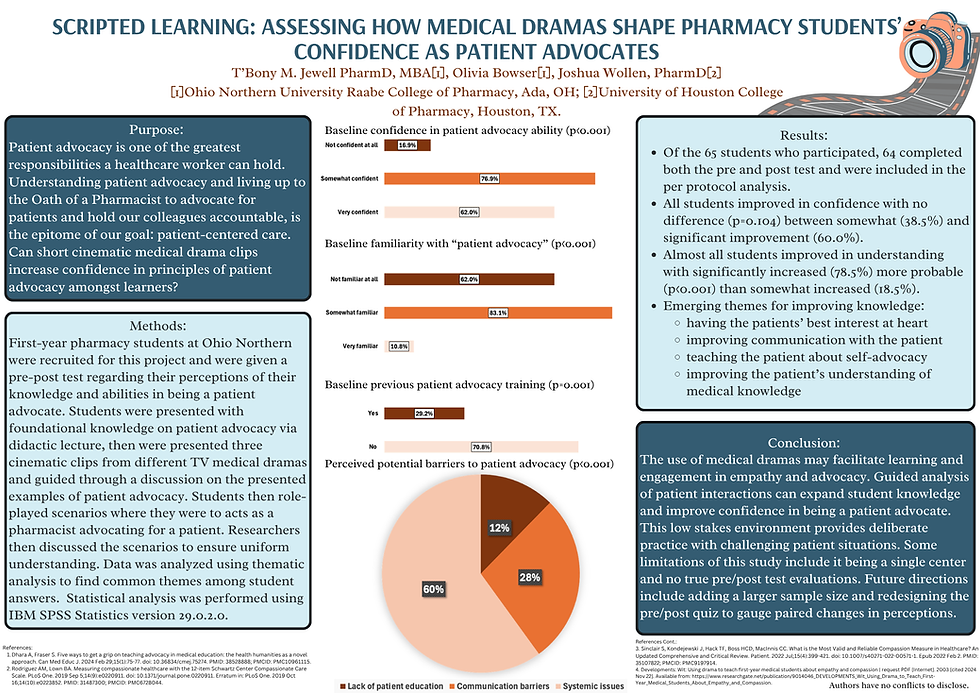
Of the 65 participants, 64 completed both the pre and post tests. A vast majority of participants, 83.1%, felt somewhat familiar with the concept of patient advocacy. When asked about their confidence in their ability to advocate for a patient, 76.9% said they were somewhat confident while 16.9% were not confident at all. Of all students surveyed, 70.8% (N=46) had no previous training or exposure to patient advocacy concepts. Following the educational session, 79.7% of students (N=51), reported a significant increase in their understanding of patient advocacy and 100% of the participants reported feeling more confident in their abilities to advocate for patients.
Students were asked about their expectations for the session. The themes that were identified from the pre-tests included learning about advocacy, strategies for being a good advocate, understanding how patients are affected and increasing their confidence. Students were also asked about how they plan to use their new and improved knowledge on patient advocacy. Major themes included “having the patient’s best interest at heart”, “improved communication with the patient”, “teaching the patient about self-advocacy”, and “improving patient understanding of medical knowledge”.
Conclusion:
Students were able to expand their knowledge about patient advocacy by incorporating cinematic clips and participating in role-playing exercises. A statistically significant number of students found the utilization of cinematic clips increased their understanding of patient advocacy and how they can participate in patient-centered care. Providing foundational knowledge to first-year, pre-professional student pharmacists about the importance of patient advocacy may strengthen their professional engagements as well as improve patient-centered health outcomes.
Authors
T’Bony M. Jewell PharmD, MBA[1], Olivia Bowser[1], Joshua Wollen, PharmD[2]
[1]Ohio Northern University Raabe College of Pharmacy, Ada, OH; [2]University of Houston College of Pharmacy, Houston, TX.


Comments