


More Than Just a Prescription
How Pharmacist Perceptions Shape Your Access to Care
Imagine you need emergency contraception or a refill on your birth control. For many, the
first stop isn't a doctor's office—it's the local pharmacy. Pharmacists are often the most
accessible healthcare providers in our communities, but does your "geographic access"
depend on more than just the distance to the front door?
The Bridge Between Knowledge and Access
Our recent research looked at pharmacists in Nebraska, Ohio, and Rhode Island to
understand what influences their comfort in providing contraceptive care. We found a
powerful tug-of-war between clinical knowledge and personal beliefs.
The Core Findings
Our study revealed that when pharmacists feel highly confident in their medical
training (clinical knowledge), they are much more likely to have positive views about
prescribing and dispensing contraception. However, personal ethical or religious
beliefs can sometimes create hesitation, particularly regarding emergency
contraception.
Why "Location" is More Than a Map Coordinate
When we talk about "geographic access," we usually think about driving distance. But our
research suggests a new way to look at it: Functional Access. Even if a pharmacy is just two
blocks away, it isn't truly "accessible" if the provider on duty feels a personal barrier to
providing the care you need.
In rural areas, this is especially critical. If the only pharmacist within 30 miles has strong
personal reservations about certain types of birth control, that community becomes a
"contraceptive desert"—not because there isn't a building, but because the perception of the provider limits the care available inside (which is their personal right).
What's Next for Our Communities?
To ensure everyone has equal access to reproductive health, we are looking toward three
major steps:
Enhanced Education: Since knowledge drives positive perceptions, continuing
education is key to increasing pharmacist comfort.
Mapping "Access Gaps": Using our data to identify regions where personal
beliefs might inadvertently limit patient options.
Supporting All Providers: Helping pharmacists navigate the balance between
their personal values and their vital role as public health leaders.
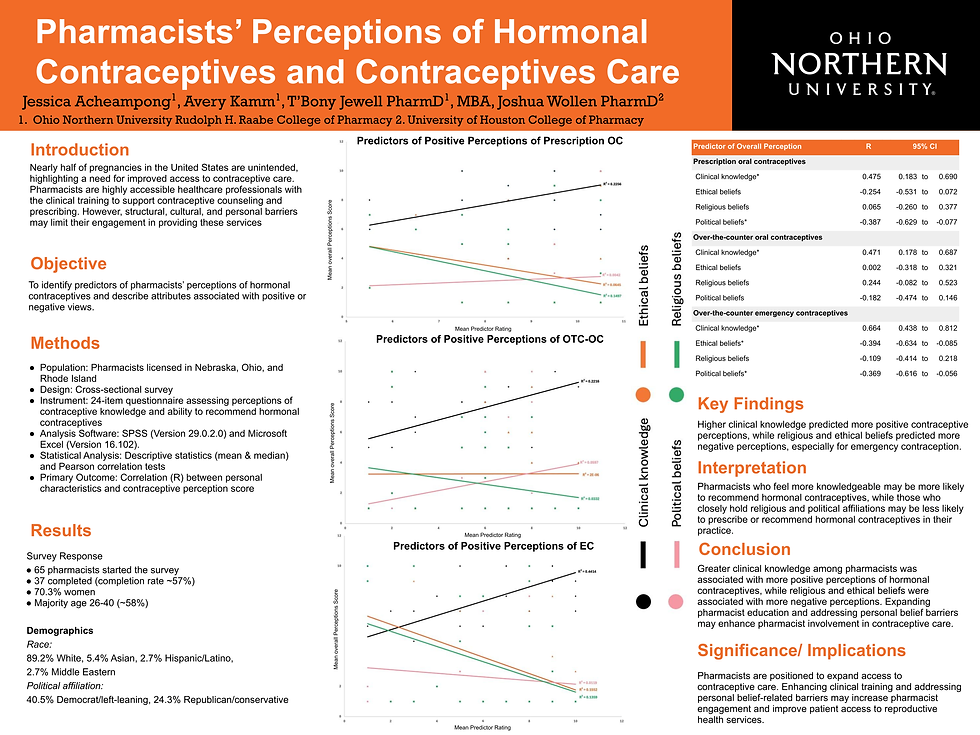
Based on research: "Pharmacists’ Perceptions of Hormonal Contraceptives and
Contraceptives Care" (Jewell et al.)

Comments