


Pharmacists Perceptions of Hormonal Contraceptives
Introduction:
In the United States, nearly 50% of pregnancies are unintended. Pharmacists possess necessary knowledge to educate patients and prescribe contraceptives to decrease these statistics. However, cultural, systemic and structural barriers exist that often limit their engagement.
Research Question or Hypothesis:
The primary objective of this study is to determine predictors of pharmacists' perceptions regarding hormonal contraceptives. Secondary objectives include describing attributes associated with positive or negative overall perceptions.
Study Design:
An anonymous cross-sectional survey was administered to licensed pharmacists in Nebraska, Ohio, and Rhode Island through Qualtrics XM.
Methods:
Registered pharmacists were surveyed, assessing perceptions of their knowledge of hormonal contraceptives and their ability to appropriately recommend options. Responses were analyzed using SPSS Version 29.0.2.0 to determine mean and median scores. A Pearson correlation test was used to determine correlation between overall contraceptive perception score and personal characteristics. The primary outcome is correlation (R) between personal characteristics and overall contraceptive perception.
Results:
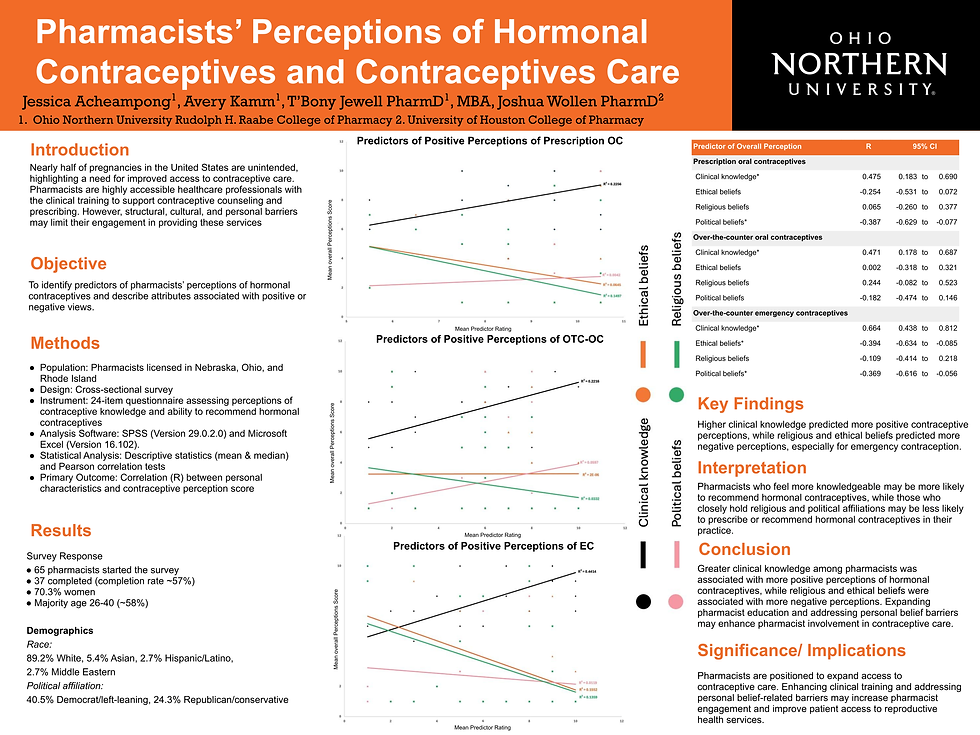
Respondents (n=37) were primarily women (70.3%), ages of 26-40 (56.8%), and white (89.2%). Political affiliation was 40.5% left leaning and 24.3% conservative. Greater clinical knowledge was positively associated with positive perceptions of pharmacists dispensing prescription contraceptives (0.475 [95% CI 0.183 to 0.690]), OTC oral contraceptives (0.471 [95% CI 0.178 to 0.687]), and OTC emergency contraceptives (0.664 [95% CI 0.438 to 0.812]).
Religious beliefs were negatively associated with prescription contraceptives (-0.0387 [95% CI -.629 to -0.077]); ethical and religious beliefs were associated with negative perceptions of pharmacists dispensing OTC emergency contraceptives (-0.394 [95% CI -0.634 to -0.085] and -0.369 [95% CI -0.616 to -0.056], respectively).
Conclusion:
Ensuring healthcare providers can provide safe, effective contraception is critical. Understanding pharmacists' perceptions presents an opportunity for state practice acts and protocols to evolve in the best interest of public health.
T'Bony M. Jewell, Pharm.D., MBA1, Joshua Wollen, Pharm.D.2, Avery Kamm 1, Jessica Acheampong1 (1)Pharmacy Practice, Ohio Northern University, Ada, OH (2)Pharmacy Practice and Translational Research, University of Houston College of Pharmacy, Houston, TX
Comments